

Help us improve CotizUp
We use cookies 🍪 to understand how CotizUp is used, improve your experience and offer you tailored content.
We use cookies 🍪 to understand how CotizUp is used, improve your experience and offer you tailored content.

This fundraising does not accept donations anymore.
___ __ CALL_
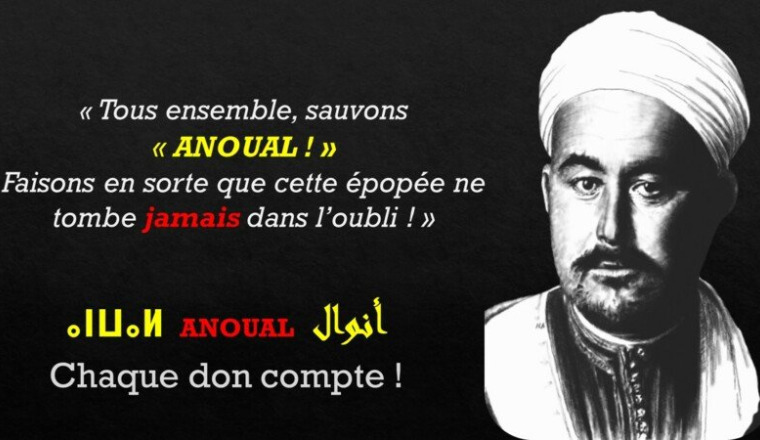
“All together, let’s save ‘ANOUAL’ and make sure this epic never falls into oblivion!”
Film trailer:
https://drive.google.com/file/d/1ZAaieth3du0jCJCnofaANKFYYhTQxlAJ/view?usp=drive_link
“ANOUAL” is a historical film. In 135 minutes, this feature-length film retraces the epic history of the uprising of the Rif mountain tribes.
Led by Mohand Ben ABDELKRIM EL-KHATTABI, known as ABDELKRIM, these valiant heroes inflict on the army of the “conquistadores”, commanded by General Manuel Fernandez SILVESTRE, a spectacular defeat that shakes the foundations of European colonial policy.
In short, this glorious victory has established itself as a model in the peoples’ struggle to free themselves from the yoke of colonialism throughout the 20th century.
What a pride it is to bring this fabulous story to the screen, to make it come alive and to make it accessible to the general public whose expectations are so high.
Dear cinema lovers,
Today, filmed in 7 weeks, “ANOUAL” is in the can! Even better, it is at its 4th editing version and runs 135 minutes.
Nevertheless, because the film “Anoual” is powerful in its historical and dramatic facts and for the sake of quality, significant post-production work remains to be done, incurring additional financial costs.
Dear friends,
Public expectations are so high and it is out of the question that, upon release, the expected quality be lacking.
That is why, dear friends, we are launching this appeal for contributions which will allow us to better enhance the highlights of this glorious victory with the best means and in the best conditions.
BUDGET DATA
_ _
_Expenses to date:_
_7 786 000,00 DHS (741 522,81 €)_
_of which_
_4 850 000,00 DHS (461 904,75 €)_
_(Advance on receipts from the Moroccan Cinematographic Center)_
__
_TOTAL BUDGET is estimated at_
_9 786 000,00 DHS (932 000,00 € )_
__
_Remaining to be covered_
_200 000,00 EUR _
_Funds allocated to:_
_Special effects, color grading, original music, mixing, voice dubbing._
__
_This appeal extends over the year 2024_
__
_Thanks to all for your support,_
_Mohammed NADRANI, Screenwriter & Producer._
----------------------------------------------------------------------------------------------------------------------------------------------------
ⴼⵓⵙ* ⴷⴻⴳ* *ⴼⵓⵙ* **
**
ⵃⵓⵎⴰ* ⴰⴷ* *ⵢⴻⴼⴼ⻓* *ⵓⵙⴰⵔⵓ* *ⵏ "ⴰⵏⵡⴰⵍ" ⵉⵃⴷⴰⵊ* *ⴽⴻⵏⵏⵉⵡ* *ⴷ* *ⴽⴻⵏⵏⵉⵏⵜ* *ⵎⴻⵔⵔⴰ* *ⴰⴷ* *ⵜⴻⵙⵡⵉⵣⴰⵎ* *ⴷⴻⴳ* *ⵡⵓⴼⵓⵖ-ⵏⵏⴻⵙ* *ⵖⴻⵔ* *ⵜⴼⴰⵡⵜ* *ⵡⴻⵔ* *ⵜⵜⵉⵛⵛⴻⵜ* *ⴱⵓ* *ⵓⴼⵓⵙ* *ⵎⵉⵏ* *ⵜⵣⴻⵎⵎⵔⴻⵎ* *ⴷⴻⴳ* *ⵉⵊⵊⴻⵏ* *ⵍⵅⴻⴷⵎⴻⵜ* *ⵜⴻⵎⵖⴰⵔ* *ⵙ* *ⵡⴰⵜⵜⴰⵙ* *ⵅ* *ⵉⵊⵊⴻⵏ* *ⵓⵎⴻⵔⴷⴰⵙ* *ⴷ* *ⴰⵔⵉⴼⵉ* *ⴽⵙⵉⵏ* *ⵣⵣⴰⵢⵙ* *ⵎⴻⵔⵔⴰ* *ⵍⴻⴳⵏⵓⵙ* *ⴰⵙⴰⵔⵓ* *ⵢⴰ* *ⵅⴻⴼ* *ⵎⵓⵍⴰⵢ* *ⵎⵓⵃⴻⵏⴷ* *ⴷ* *ⵓⵎⴻⵏⵖⵉ* *ⵏ* *ⵡⴰⵏⵡⴰⵍ.* **
----------------------------------------------------------------------------------------------------------------------------------------------------
Film description
“Anoual” is a historical narrative film based on well-documented historical events and presents the confrontation of the Rif tribes with European colonial domination, led specifically by the Spanish state as the colonial power in the Rif. The film portrays the personal trajectory of Prince “Abd al-Karim al-Khattabi” and how his personality evolved from a civil servant in Melilla to a revolutionary military leader who defeated the Spanish army in the famous Battle of “Anoual,” a victory that became regarded as a school of resistance and a cornerstone for what later became known as guerrilla warfare (Guérilla), as attested by prominent leaders of global liberation movements, notably Mao Zedong, Ho Chi Minh, Che Guevara and others.
The film therefore explores the development that took place in the personality of Prince “Abd al-Karim al-Khattabi,” who became a fierce opponent of expansionist colonial policies. This film presents the key political events that influenced his character and produced in his psyche what amounts to a radical upheaval.
The film gives strong emphasis to the spark that ignited Prince “Abd al-Karim al-Khattabi”’s anger: as a jurist graduated from the University of al-Qarawiyyin, he saw the Spaniards appease the Triple Entente against the “Central Powers” led by Germany, and especially the Ottoman state, which Muslims sympathized with, including Prince Abd al-Karim al-Khattabi. He expressed that sympathy in an article in the newspaper “El Telegrama del Rif,” which led to his prosecution and imprisonment by the Spaniards. This event represented a decisive turning point for the Prince, and after his release he returned to his family openly holding emancipatory ideas he no longer hid, and he immediately set about shaping them by healing the rift that existed among the Rif tribes. Through his prudence and determination he unified those tribes into a single, cohesive entity, using local capabilities to confront and even break the strength of one of the most formidable colonial armies whose renown and presence reached the farthest reaches of Latin America and African jungles, an epic recounted in historical annals and references as the “Anoual” saga and its leader Prince Abd al-Karim al-Khattabi.
Regarding the immediate context of producing the film “Anoual,” it comes as part of commemorating the centenary of the Battle of “Anoual” (July 1921 - July 2021), an anniversary that historical chance aligned with the events that occurred in the Rif region known as the Hirak, which resulted in social uprisings and subsequent arrests whose victims remain imprisoned to this day.
Beyond reviving the glories of the Rif and its people, the film Anoual is fundamentally a rehabilitation of the Rif region and its historical role in protecting the nation’s northern borders. It contributes cinematically to combating marginalization and the logic of dividing the country into a “useful” and “non-useful” Morocco—an approach reflected in some practices on the ground. Moreover, the production of Anoual is part of our interest in historical-fiction films that restore historical facts with a creative touch.
Project methodology:
It must first be noted that this project represented for us—be it as screenwriter, producer, or director—an obsession to fulfill a cherished wish: to immortalize the historical epic of “Anoual” and the events that led to it through a cinematic work in the form of an epic historical feature film with a creative touch that distances it from direct propaganda or a triumphalist bent.
The first step in carrying out this project was to rely on reliable historical references, subjecting them to analysis and critique and adapting them to the artistic creative treatment that preserves the historical essence of the events without falsification or distortion.
Accordingly, the primary aim of the artistic approach was to achieve the golden equation that respects historical truth without sacrificing the stewardship of the artistic achievement as a work that attains the desired balance between truth and artistic enjoyment.
After this essential phase, it became clear to us that the Anoual epic, being a decisive battle constantly mentioned in historical records—and which hardly ever fails to appear in any dossier on the history of the Rif region in northern Morocco in the early twentieth century—cannot be told without narrating the events, transformations and conflicts that led to it on the one hand, and without recounting the biographical path that made Prince Abd al-Karim al-Khattabi the political and military leader of this epic on the other hand.
After completing the screenplay in light of these data, it became apparent that the film “Anoual” in terms of production is not an ordinary film compared to the films typically released by Moroccan production windows. Initially, we considered involving Spanish production windows in the project given the shared history that would attract their interest, and even their participation in some form in realizing this project.
However, due to a political dispute that erupted between Morocco and Spain at the time, resulting in the closure of borders and the freezing of diplomatic and cultural relations, it became impossible to travel to and from Melilla, which affected the film’s production budget with lower costs. We were therefore compelled to rely on the internal support available to us, such as advances on receipts and funds from the cinematographic support fund, which resulted in constraints and challenges that continue to hinder the completion of the final version of the film in a way that honors the effort we invested in the writing and the directorial vision, which aimed for a “minimalist” aesthetic that does not shortchange the image we want for this film—this dream—which brings us to the challenges of the project discussed in the following section of this report.
Project challenges:
We are proud today, as the film’s artistic and technical crew, to have completed filming within reasonable deadlines made possible by advances on receipts from the cinematographic center, as well as the self-financing contributed by the producer, estimated at 2 million dirhams.
Although shooting the battle of “Anoual” and the maneuvers and amphibious landings that preceded it—such as the symbolic turning point—and the artistic weight required to depict the battle’s events with all their ferocity and the heavy equipment like horses, artillery, tents and camps was an ambitious undertaking, it was not fully feasible because the battle of “Anoual” was fought against the legendary cavalry unit “La Quintrala” (la «quntra»), a force that had never lost a single war over centuries.
The solution was to film all of that in measured, meticulously calculated sequences that allow us in post-production to resort to visual effects technology to present them in the quantity and appearance befitting the historical specifications of the battle and as agreed upon in authoritative references.
Target audience:
History books assert that the battle of “Anoual” transformed the Rif tribes in the farthest reaches of Morocco from tribalism to internationalism, since its military achievement and historic victory in the battle of “Anoual” became a global gain adopted by other peoples. Therefore, the film targets Moroccan and Maghrebi audiences, and indeed freedom-loving audiences worldwide.
Unusually, the film’s production attracted the attention of nearly all national media outlets across their various components, and its shooting was accompanied by prolonged and broad debate and discussion regarding the expectations of the general public and the different forces and actors of society.
Given the financial shortfall in bringing the Anoual epic to the screens, and at the suggestion of a number of cultural actors and many concerned citizens, we decided to open an electronic donation fund to support this legendary work.
We count on your generous support and contributions to bring this epic into being so that it does not fall into oblivion.
Words from Mohammed Nadrani, screenwriter and producer of the film Anoual.


According to our statistics, a single share raises an average of 30 euros.
Fundraising link :
Reply to